
Official Polk Arrest News Sources
Start with the agencies themselves. The Polk County Sheriff's Office posts news on major arrests, wanted persons, and open investigations, with a News & Events feed on its mobile app. These are handpicked announcements. They are not a full arrest log. A slow news day says nothing about jail traffic. City departments work the same way. Ankeny Police News is the clearest direct city channel. Des Moines Police and West Des Moines information releases also put out event-driven updates. None of the three runs a daily mugshot blotter.
Geography complicates things. Des Moines sends every arrestee to the Polk County Jail. Ankeny cases move to the county jail channel after admission. West Des Moines straddles county lines, so a city story may still need a county check. For anyone booked at the county level, the Polk County jail and booking feeds show whether the person is in custody now, inside a rolling booking window, tied to an earlier date, or already released.
Polk Crime Outlets Compared
Metro newsrooms write on their own editorial clock. A booking does not guarantee a story. Editors pick what has public impact, and the images that run may be crime scenes, video stills, agency handouts, or the occasional booking photo.
| Outlet | Coverage | Photos? | Where |
|---|---|---|---|
| Polk Sheriff | Selected county investigations, wanted items, safety news | Sometimes, as relevant | Official Sheriff site |
| Ankeny Police | Selected city police releases | Varies by release | Police News |
| Des Moines Register | Crime and courts across Polk and metro cities | Editorially selected | Crime & Courts |
| KCCI 8 | Selected local crime throughout the week | Video, scenes, agency media, occasional subject photos | Local News |
| WHO 13 | Event-driven central Iowa crime reports | Selective editorial imagery | Crime |
| Local 5 | Central Iowa crime, including Polk metro cities | Varies by story | Crime |
| Axios Des Moines | Selected higher-impact public safety and court news | Not a mugshot service | Des Moines desk |
Among the outlets, the Register runs the strongest dedicated crime-and-courts section. KCCI files its crime stories under Local News rather than a standalone vertical. WHO 13 and Local 5 both keep active crime streams. Axios plays a supplementary role and skips routine bookings. Expect the occasional paywall or access limit, none of which changes what the official record says.
Why Polk Mugshot Coverage Splits
Polk County's publication world splits in two. Mainstream metro outlets run selected, event-driven stories and use mugshots only some of the time. Unofficial aggregators mass-publish booking cards and photo archives instead. Ankeny offers a direct Police News stream, though it also picks and chooses events. No single news page can act as a complete arrest list.
Each side has trade-offs. Editorial reporting brings investigator statements, interviews, court documents, and follow-ups that a booking entry never holds, but an old headline can freeze the earliest version of events long after the case moves on. Aggregator cards cast a wider net yet run thin, duplicated, mislabeled, or stale. For custody, only the Sheriff counts; for case outcomes, Iowa Courts Online is the source of record.
How Polk Booking Photos Reach News
How does a booking photo land at a newsroom? Usually through an agency release, a public-record request, or an official jail profile. Iowa Code chapter 22 sets the public-record framework, but confidentiality laws and court orders still govern specific material. The state code contains no statute specifically governing mugshot publication or banning pay-to-remove schemes. That gap does not make every image public in every case.
Polk's own roster rewards a targeted check. The top-level list is text only. The person-level "View" profile can hold the photograph. A newsroom may decline to publish it even with full access, and juvenile, sealed, expunged, or active-investigation material can follow separate access rules entirely.
Careful wording stays tied to time. Say "the jail record listed," "police alleged," or "the person was charged," and reserve "convicted" for a verified judgment. When an agency corrects a name, charge, or photo, older articles and reposts may lag behind.
Trace Polk News to Records
Work from the story back to the source, in a fixed order. That keeps an editor's report, the Sheriff's booking record, and the Judicial Branch's disposition record from blurring into one another.
- Read the full story and note the named agency, event date, booking date if given, and any court case number. A publication date is not necessarily the arrest date.
- Use Polk’s current roster for present Sheriff custody. Use Bookings Previous 24 Hours for rolling intake or Bookings Prior Date for a known calendar date.
- If the person is no longer current, check release views. The Released Inmate Search covers releases during the preceding 365 days and needs exact identifying input.
- Open the person-level jail profile only to confirm the relevant identity and booking. Do not treat the listed charge or bail field as the outcome.
- Search Iowa Courts Online, preferably with the case number. Match Polk County, identity, dates, and case type, then read through the latest docket entry.
- If the online window has passed, request the Sheriff record. For a city incident report, use the arresting police department’s records process.
A roster entry that disappears does not mean acquittal. Release can follow bond, a court order, a transfer, completed sentencing, or something else entirely. The same caution applies in reverse: an old aggregator card proves nothing about present custody. One more wrinkle: Polk bars federal-charge inmates from its public jail lists, so federal cases call for the matching federal source.
Unofficial Polk Mugshot Publishers
Third-party county sections sit behind the official channels. They are not government services. Their presence does not prove current custody, and their absence does not prove no arrest. Check every entry against the Sheriff and the court docket. Mugshots.zone has no local Polk County section, so a generic homepage should not be mistaken for local coverage. RecentlyBooked's Polk section advertises a rolling 30-day set of booking cards refreshed multiple times daily, but those are publisher claims rather than any county guarantee.
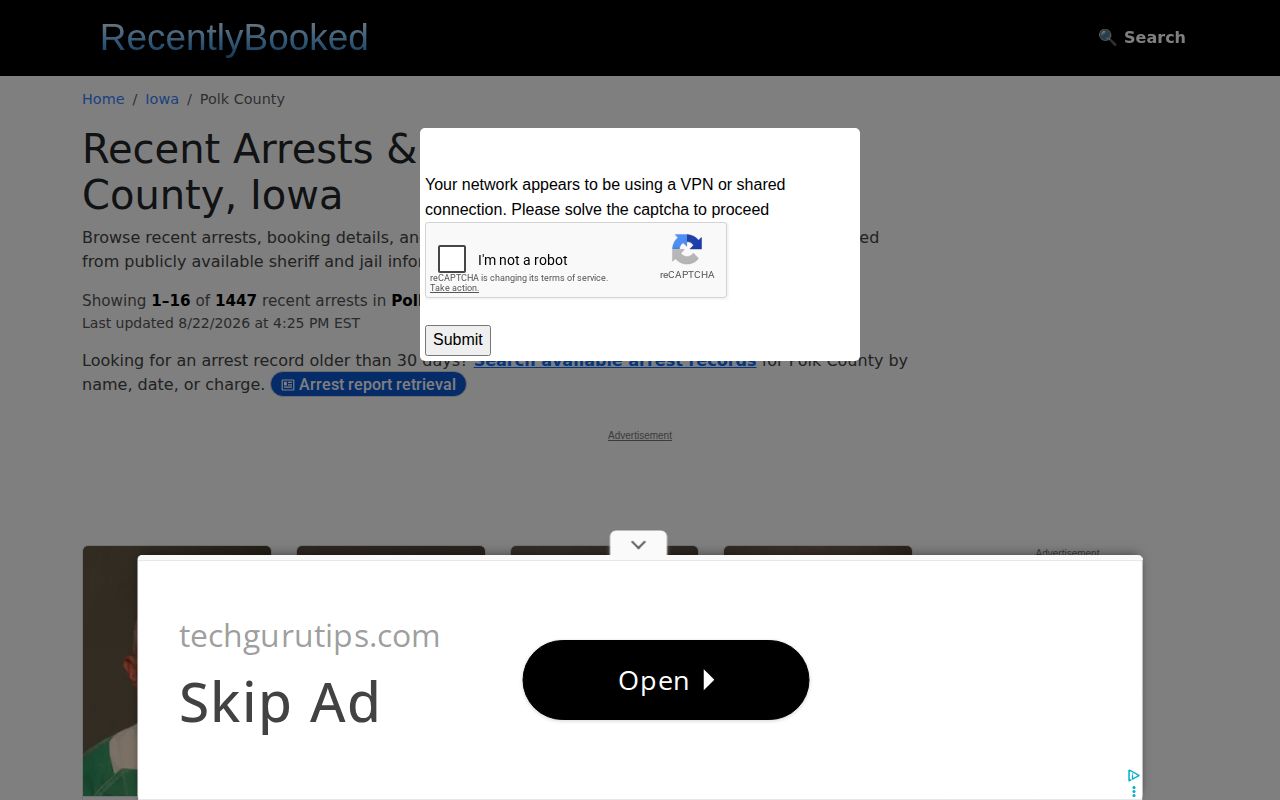
A single captured page tells you very little on its own. City names, booking details, and custody status all need confirmation through official sources. Treat the screenshot as a starting point. Nothing more.
Mugshots.com's Polk County category holds older individual records. A listing there can surface long after the booking. The date a record was added rarely matches the date of the arrest.
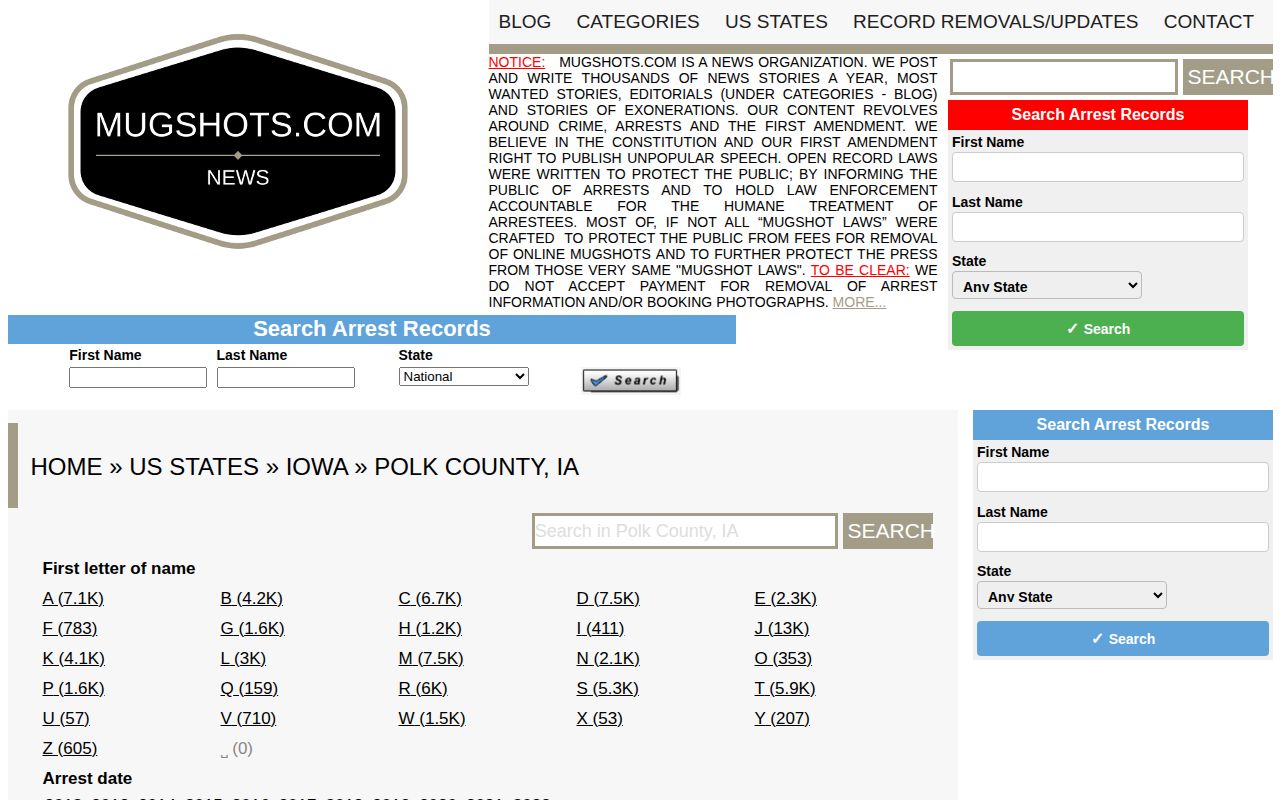
An old entry proves nothing about current custody. The older the listing, the weaker it gets. It cannot tell you whether someone sits in the Polk County jail today.
Arrests.org's Polk path sorts booking-report material by date, which sounds tidy. The coverage is spotty in practice, and parts of the site sit behind access protections. Expect gaps rather than a complete Polk arrest record.
Do not read an empty result as proof. A zero count, a blocked page, or a missing day on a secondary site shows nothing about what Polk recorded. Busted Newspaper keeps its own Polk section too. It never says where its listings come from. Whatever publisher you start with, the official record is the final stop.
Polk Arrest News by City
Each Polk city has its own arrest-news angle. Des Moines Busted Mugshots ties DMPD's selected releases to the county jail, since DMPD says every person it arrests goes there. Ankeny Busted Mugshots pairs the city's Police News feed with Polk booking records created after admission. West Des Moines Busted Mugshots leans on jurisdiction, because that city stretches across Polk, Dallas, and Warren counties.
Metro newsrooms cover all three cities now and then. Their story choices do not measure arrest volume. For a case you already know about, start by naming the arresting agency and the county of booking. Then pull the right jail record and court docket. That habit keeps a West Des Moines incident from landing in the wrong county system.
Wording differs between a police release and a jail booking profile for a simple reason. Police describe the investigation and arrest. Jail staff fill in intake fields. Prosecutors later decide what to file, and judges run the court case, so a charge label can shift from one stage to the next. Keep each source's own date and language rather than merging them into one account nobody actually published.
A known booking date makes Polk's Prior Date view far more precise than digging through news archives. The Previous 24 Hours view is a rolling window, not a calendar day, and the current roster answers only who is in custody right now. Separate release views track exits. That structure lets you follow the sequence behind a story without assuming a case ended just because a name left the roster.
Sentenced to state prison? The Iowa Department of Corrections search is the right custody source, and it covers only that corrections stage, not every Polk arrest. Federal cases call for a federal locator or direct agency contact, since Polk leaves federal-charge inmates off its published jail lists. The news article is a lead; the correct custodian gives you the status.